


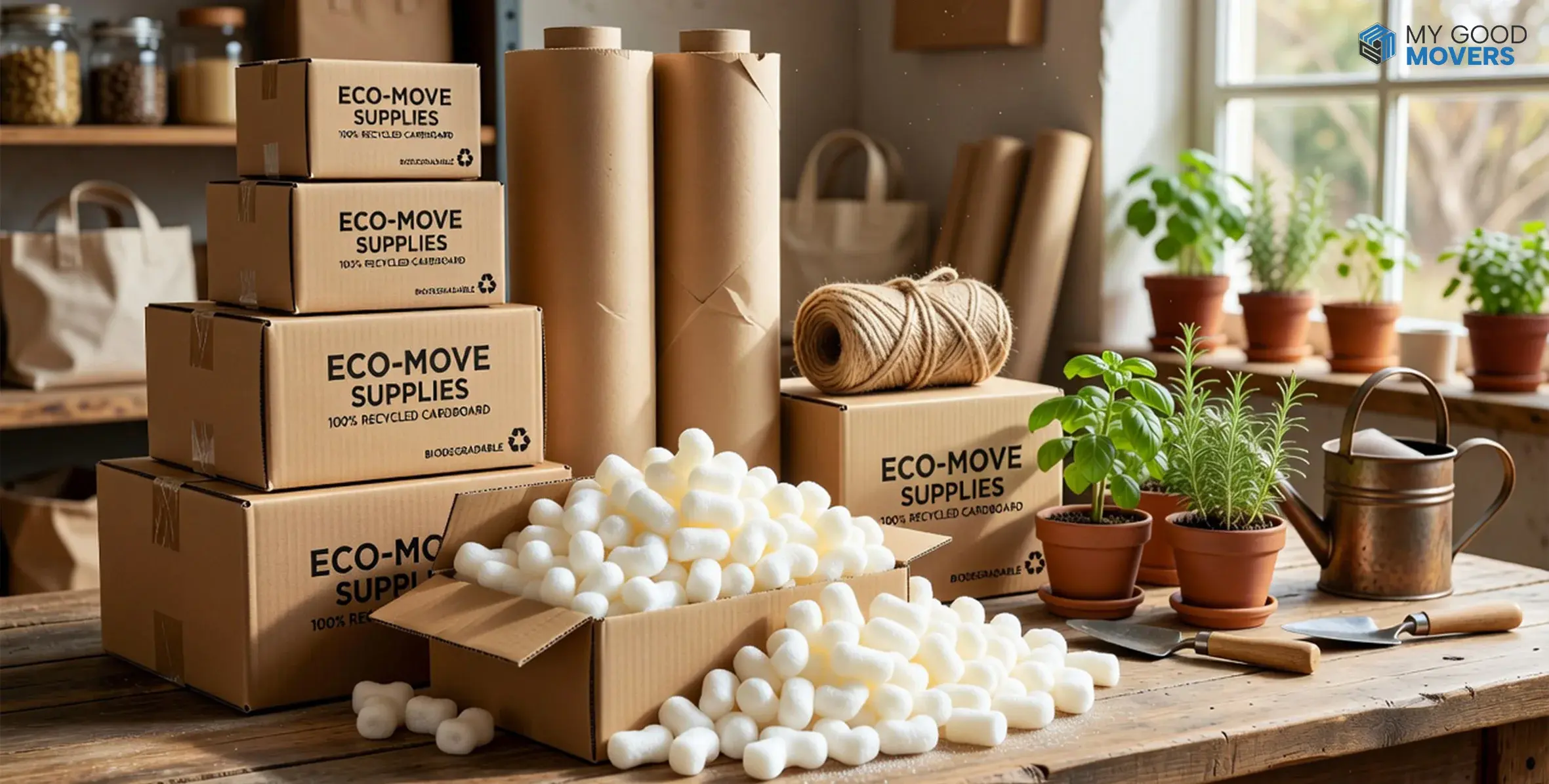
Quick answer: The best eco-friendly packaging materials include recycled cardboard boxes, reusable moving bins, kraft paper, honeycomb paper wrap, biodegradable packing peanuts, and water-activated paper tape. These materials help reduce waste while still offering solid protection during cross-country moves.
Overview
“The smallest wrapper can leave the longest mark.”
You may not think much about the box, mailer, tape, filler, or wrap you use for a product or a move. Most people do not. They think about getting the item delivered safely or making packing less stressful. But that small packaging choice continues its journey long after you are done with it. That is why it is important to choose eco friendly packaging materials.
Did you know
In the United States, containers and packaging create 82.2 million tons of municipal solid waste, which is 28.1% of total waste generation.
Globally, around 36% of all plastics produced are used in packaging, and a large share of single-use plastic food and beverage containers ends up in landfills or as mismanaged waste.
These stats are concerning, that’s why we need to “Go Green” in our moving as well. And sustainable packaging materials can help you reduce waste without making packing more complicated.
Before spending money on trendy “green” packing products that may not hold up during transit, it’s important to know which eco-friendly supplies truly work for moving and which to avoid.
Can Eco-Friendly Packaging Supplies Handle Long-Distance Moves?
Yes, durable, eco-friendly packing supplies can safely handle long-distance and even international moves when packed properly.
Modern eco-friendly materials are much stronger than many people expect. High-quality recycled boxes, kraft paper, reusable bins, and reinforced paper tape are designed to survive:
- Truck vibration
- Heavy stacking
- Long transit periods
- Moisture exposure
What Are Eco-Friendly Packaging Materials?
When people hear the word “eco-friendly,” they often imagine packing supplies that are weak, rough, or not protective enough for a real move. But that is not true anymore.
Today, eco-friendly packaging materials can help you pack dishes, clothes, books, furniture, electronics, and fragile items without depending on plastic-heavy supplies.
Here are some of the most common materials you will come across:
| Eco-Friendly Material | How It Can Be Used During a Move |
|---|---|
| Recycled cardboard | Moving boxes and dividers |
| Corrugated cardboard | Heavy-duty moving boxes |
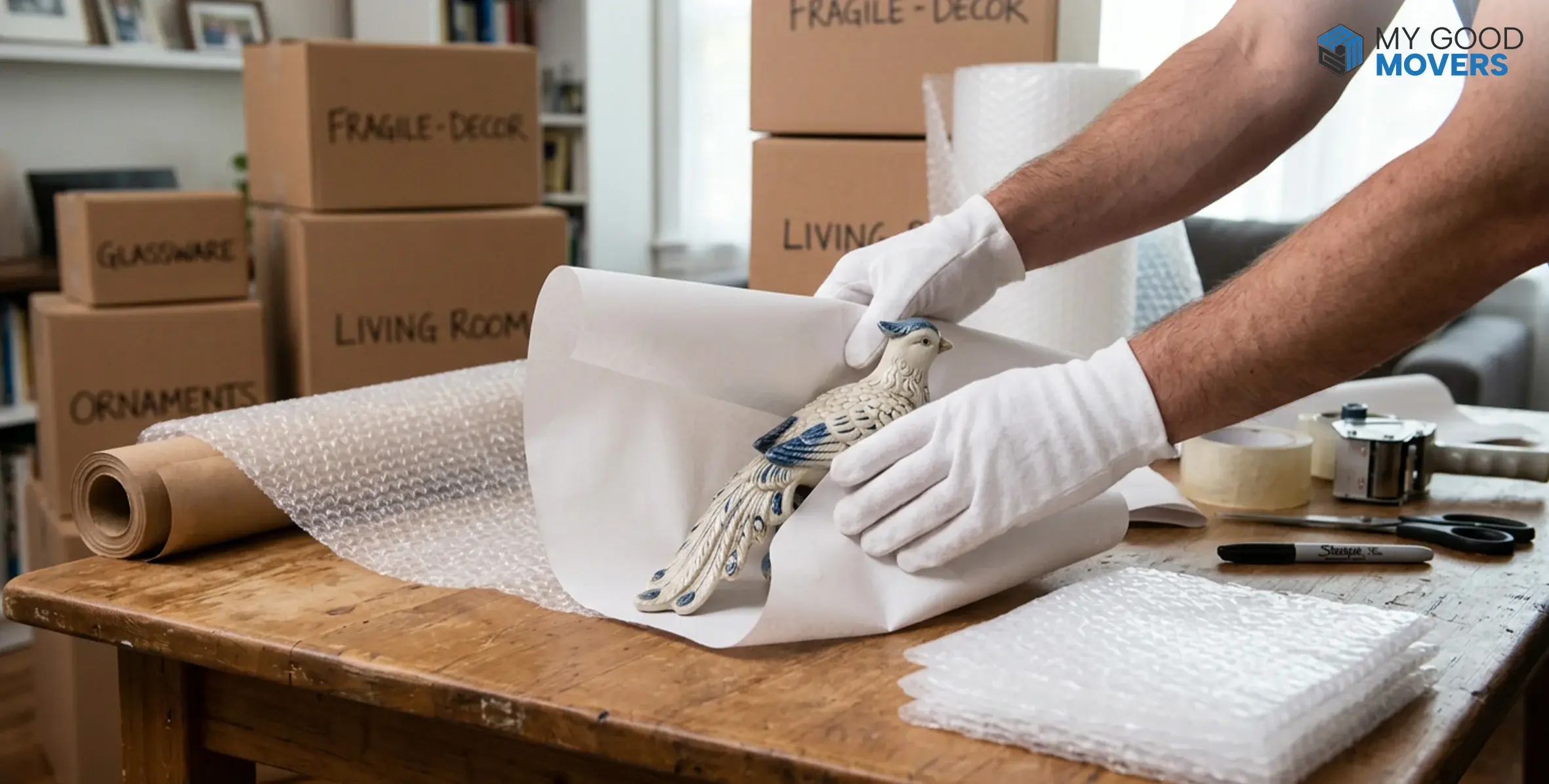
| Kraft paper | Wrapping fragile items |
| Recycled packing paper | Filling empty spaces |
| Honeycomb paper | Bubble wrap alternative |
| Biodegradable packing peanuts | Void filling |
| Compostable mailers or bags | Small soft items |
| Mushroom packaging | Fragile item protection |
| Paper tape | Sealing boxes |
| Reusable bins | Replacement for single-use boxes |
What Makes a Packaging Material Eco-Friendly?
A packaging material becomes eco-friendly when it creates less harm before, during, and after use. It is not only about how the material looks.
Here is what you should look for:
- It is made from recycled, renewable, or responsibly sourced material.
- It can be reused, recycled, composted, or broken down safely after use.
- It uses less plastic or avoids plastic completely.
- It protects the product well, so items do not get damaged or wasted.
- It does not require too much energy, water, or harmful chemicals to produce.
- It fits the purpose instead of being oversized or overpacked.
Biodegradable packaging materials can also be useful when they are made for the right situation.
Compostable packaging materials are even better when the user has access to proper composting conditions.
And recyclable packaging materials work well when they are clean, clearly labeled, and accepted by local recycling programs.
So, when you choose eco-friendly packaging materials, do not only ask, “Is this green?” Ask, “What happens to this after I am done with it?”
How We Selected these Best Eco-Friendly Packaging Materials
We evaluated each material using environmental impact, recyclability, protection performance, availability, cost-effectiveness, and user convenience to identify the most practical eco-friendly packaging options.
A packaging material should not be called “best” just because it has a green label, a brown color, or the word natural printed somewhere on it.
Some materials look eco-friendly, but they are hard to recycle. Some are compostable, but only in industrial composting facilities. Some are recyclable, but only if the user knows how to dispose of them properly.
So, instead of making a random list, we used a clear selection method to decide which materials deserve a place among the best eco-friendly packaging materials.
Here is the selection criteria we used:
What We Focused on Most
The following factors had the greatest impact on our selection and ranking process.
| Selection Criteria | Weight |
|---|---|
| Environmental Impact | 25% |
| End-of-Life Option | 20% |
| Protection & Performance | 20% |
| Practical Availability | 15% |
| Cost & Value | 10% |
| User Convenience | 10% |
Each material was reviewed against the six criteria above and given a total score out of 100. Only materials that scored 75 or higher made it into our final list.
Here is how we treated the scores:
| Score Range | What It Means |
|---|---|
| 90 to 100 | Excellent choice. Strong environmental value, practical use, and reliable performance. |
| 80 to 89 | Very good choice. Works well in most situations with only a few limitations. |
| 75 to 79 | Good choice. Useful and eco-conscious, but may depend on the right use case. |
| Below 75 | Not selected. The material may still have benefits, but it did not perform strongly enough across our full criteria. |
More About Our Selection Process
We kept the minimum score at 75 because a material must be better for the environment and realistic for the people using it. If something is difficult to find, too expensive for regular use, weak in protection, or confusing to recycle or compost, we did not add it to the list.
Best Eco-Friendly Packaging Materials
These are the best eco-friendly packaging materials because they are better for the planet and practical for real moving needs.
1. Recycled Paper and Cardboard Packaging
| Selection Criteria | Score |
|---|---|
| Environmental Impact | 23/25 |
| End-of-Life Option | 19/20 |
| Protection and Performance | 17/20 |
| Practical Availability | 15/15 |
| Cost and Value | 9/10 |
| User Convenience | 10/10 |
| Total Score | 93/100 |
Recycled paper and cardboard are the kind of packaging materials that make sense almost instantly. You already know how they work, your customer knows how to handle them, and most recycling systems already accept them when they are clean and dry.
That is why we selected them. They are simple, useful, and not confusing.
You can use recycled paper and cardboard for:
- Shipping boxes
- Moving boxes
- Paper fillers
- Product wraps
- Retail packaging
- Storage packaging
A cardboard box protects the item, it can often be reused, and it can usually go into the recycling stream. That makes it one of the most practical recyclable packaging materials for everyday use.
2. Kraft Paper Packaging
| Selection Criteria | Score |
|---|---|
| Environmental Impact | 22/25 |
| End-of-Life Option | 18/20 |
| Protection and Performance | 15/20 |
| Practical Availability | 14/15 |
| Cost and Value | 10/10 |
| User Convenience | 9/10 |
| Total Score | 88/100 |
Kraft paper is simple, but it does a lot of work. You can wrap products with it, fill empty space inside boxes, cover fragile items, or use it as a cleaner alternative to plastic fillers.
We selected kraft paper because it is one of the easiest eco-friendly packing supplies to start using. You do not need special tools, special training, or a complicated packing process. You just replace some of the plastic cushioning with paper-based protection.
It works best for:
- Small product packaging
- Gift wrapping
- Box fillers
- Books, décor, and household items
- Light protection during shipping or moving
Kraft paper may not be enough for very fragile items on its own, but when you pair it with a strong box, it becomes very useful. It is affordable, easy to find, and easy for the user to reuse or recycle.
3. Corrugated Cardboard Packaging
| Selection Criteria | Score |
|---|---|
| Environmental Impact | 24/25 |
| End-of-Life Option | 20/20 |
| Protection and Performance | 19/20 |
| Practical Availability | 15/15 |
| Cost and Value | 8/10 |
| User Convenience | 9/10 |
| Total Score | 95/100 |
Corrugated cardboard got the highest score because it gives you the balance most people want: strength, easy availability, and a good end-of-life option.
If you have ever moved houses, shipped a product, or stored items in a garage, you already know why corrugated cardboard matters. It is not just paper. The wavy layer inside gives it strength and helps it handle pressure during stacking, shipping, and moving.
This is a great choice for:
- Shipping boxes
- Heavy product packaging
- Moving boxes
- Fragile item protection
- Inserts and dividers
For someone planning an eco-friendly move, corrugated cardboard is usually one of the smartest packing materials. It is strong, easy to label, easy to stack, and easy to recycle after use.
4. Compostable Mailers
| Selection Criteria | Score |
|---|---|
| Environmental Impact | 20/25 |
| End-of-Life Option | 17/20 |
| Protection and Performance | 16/20 |
| Practical Availability | 12/15 |
| Cost and Value | 7/10 |
| User Convenience | 8/10 |
| Total Score | 80/100 |
Compostable mailers are a good option when you are shipping lightweight products and want to move away from traditional plastic mailers.
They work well for:
- Clothing
- Soft goods
- Accessories
- Documents
- Lightweight e-commerce products
We selected them because they are a useful step toward plastic-free packaging alternatives. They feel familiar to the user, but they are designed with a better disposal path in mind.
“Compostable packaging works best when the user knows what to do with it.”
That is why compostable mailers scored well, but not at the very top. They are helpful, but they depend on the right disposal system.
5. Cornstarch Packaging Material
| Selection Criteria | Score |
|---|---|
| Environmental Impact | 21/25 |
| End-of-Life Option | 16/20 |
| Protection and Performance | 15/20 |
| Practical Availability | 11/15 |
| Cost and Value | 6/10 |
| User Convenience | 7/10 |
| Total Score | 76/100 |
Cornstarch packaging is made from plant-based material instead of traditional petroleum-based plastic. You may see it used in bags, films, loose-fill packaging, and some food packaging items.
We selected it because it gives people another option when they want biodegradable packaging materials that are closer to plastic but are made from renewable sources.
It works best for:
- Food packaging
- Lightweight bags
- Loose-fill cushioning
- Short-term packaging needs
But cornstarch packaging is not perfect for every situation. It needs the right disposal conditions, and not every customer will know whether to compost it, throw it away, or handle it differently.
So, we added it to the list because it has real potential, but we gave it a lower score because it needs clearer disposal guidance.
6. Mushroom Packaging Material
| Selection Criteria | Score |
|---|---|
| Environmental Impact | 25/25 |
| End-of-Life Option | 19/20 |
| Protection and Performance | 18/20 |
| Practical Availability | 9/15 |
| Cost and Value | 6/10 |
| User Convenience | 8/10 |
| Total Score | 85/100 |
Mushroom packaging is one of the most interesting materials on this list. It is made from mycelium, which is the root-like structure of mushrooms, combined with agricultural waste.
In simple words, it grows into a protective shape instead of being manufactured like foam.
We selected it because it can replace foam packaging in many cases, especially for products that need cushioning.
It works well for:
- Glass items
- Candles
- Electronics
- Cosmetics
- Fragile products
- Premium packaging inserts
The best thing about mushroom packaging is that it gives you protection without depending on plastic foam.
The reason it did not score higher is availability and cost. It is not as easy to find as cardboard or kraft paper, and it may not fit every budget.
7. Bagasse Packaging
| Selection Criteria | Score |
|---|---|
| Environmental Impact | 23/25 |
| End-of-Life Option | 18/20 |
| Protection and Performance | 14/20 |
| Practical Availability | 10/15 |
| Cost and Value | 7/10 |
| User Convenience | 8/10 |
| Total Score | 80/100 |
Bagasse packaging is made from sugarcane fiber. After sugarcane juice is extracted, the leftover fiber can be shaped into plates, bowls, trays, and takeaway containers.
We selected bagasse because it gives food businesses a better option than foam or plastic containers.
It is useful for:
- Takeaway food boxes
- Plates and bowls
- Food trays
- Café and restaurant packaging
- Catering packaging
Bagasse has a natural, sturdy feel, which makes it attractive for food packaging.
The only thing to watch is coating. Some bagasse packaging has added coatings to resist grease or liquids.
So, the simple rule is to choose certified bagasse packaging when possible, especially if you want to compost it properly.
8. Seaweed-Based Packaging
| Selection Criteria | Score |
|---|---|
| Environmental Impact | 24/25 |
| End-of-Life Option | 18/20 |
| Protection and Performance | 12/20 |
| Practical Availability | 7/15 |
| Cost and Value | 5/10 |
| User Convenience | 9/10 |
| Total Score | 75/100 |
Seaweed-based packaging is one of the most creative options in packing materials. It can be used for films, sachets, food wraps, coatings, and in some cases, even edible packaging.
We selected it because it is renewable, lightweight, and designed to reduce dependence on plastic.
It works best for:
- Food wraps
- Sauce sachets
- Single-use food packaging
- Small flexible packaging
- Innovative product packaging
But seaweed-based packaging is not ready to replace every box, mailer, or protective insert. You would not use it to pack heavy items or manage a full house move.
That is why it scored 75. It made the list because it is innovative and promising, but it is still not as practical or widely available as paper, cardboard, or reusable packaging.
9. Reusable Packaging
| Selection Criteria | Score |
|---|---|
| Environmental Impact | 22/25 |
| End-of-Life Option | 15/20 |
| Protection and Performance | 20/20 |
| Practical Availability | 13/15 |
| Cost and Value | 9/10 |
| User Convenience | 10/10 |
| Total Score | 89/100 |
Reusable packaging is different from the other options because it does not only ask, “How can we dispose of this better?” It asks, “Can we use this again instead of throwing it away?”
That is why we selected it.
Reusable packaging includes:
- Reusable moving bins
- Fabric bags
- Tote bags
- Returnable mailers
- Refillable containers
- Durable crates
- Storage boxes
If you are planning a move, reusable bins and bags can reduce the need for single-use boxes, plastic wrap, and extra fillers.
The only condition is that reusable packaging must actually be reused. If it is used once and forgotten, it loses much of its value. But when it becomes part of a routine, it can be one of the strongest packing materials on this list.
10. Recycled Plastic Packaging
| Selection Criteria | Score |
|---|---|
| Environmental Impact | 18/25 |
| End-of-Life Option | 14/20 |
| Protection and Performance | 19/20 |
| Practical Availability | 14/15 |
| Cost and Value | 8/10 |
| User Convenience | 7/10 |
| Total Score | 80/100 |
Recycled plastic packaging is the option we include carefully. It is not the cleanest material on the list, and it should not be used when paper, cardboard, compostable, or reusable options can do the same job.
But it still has a place.
We selected it because some products need moisture resistance, flexibility, or strong protection. In those cases, recycled plastic can be a better choice than using brand-new plastic.
It works best for:
- Moisture-sensitive products
- Flexible packaging
- Protective wraps
- Durable mailers
- Products that need a strong barrier
Quick Comparison Table
| Packing Supply | Best For During a Move | Protection Level | Reusable |
|---|---|---|---|
| Recycled Paper and Cardboard | General household packing, books, kitchen items, clothes | High | Limited |
| Kraft Paper | Wrapping dishes, glasses, décor, and small, fragile items | Medium | Limited |
| Corrugated Cardboard | Moving boxes, heavy items and fragile item separation | Very High | Limited |
| Compostable Mailers | Packing small soft items, documents, cables, and accessories | Low to Medium | Limited |
| Cornstarch Packaging Material | Light cushioning and void filling inside moving boxes | Medium | No |
| Mushroom Packaging Material | Protecting fragile décor, glassware, lamps, and delicate pieces | High | No |
| Bagasse Packaging | Separating small kitchen items, drawer items, or lightweight belongings | Low to Medium | No |
| Seaweed-Based Packaging | Use for small, lightweight, non-fragile items | Low | No |
| Reusable Packaging | Moving bins, fabric bags, storage containers, and repeat-use packing | Very High | Yes |
| Recycled Plastic Packaging | Moisture protection for toiletries, liquids, and spill-risk items | High | Limited |
Want a Complete Packing Plan?
Stop guessing what to pack next. Follow a clear packing plan that helps you move room by room without the usual last-minute chaos.
Read How to Pack for a MoveEco-Friendly Alternatives to Common Plastic Packaging
| Common Plastic Packaging | Eco-Friendly Alternative for Moving |
|---|---|
| Bubble Wrap | Kraft paper, honeycomb paper wrap, towels, old clothes, moving blankets |
| Plastic Mailers | Reusable fabric bags, paper bags, compostable mailers and small recycled cardboard boxes |
| Foam Peanuts | Crumpled kraft paper, shredded recycled paper, biodegradable packing peanuts and cornstarch loose fill |
| Styrofoam Packaging | Mushroom packaging, molded paper pulp, corrugated cardboard inserts, thick paper padding |
| Plastic Tape and Labels | Paper tape, water-activated paper tape, recycled paper labels, removable paper labels |
Where Can You Buy Eco-Friendly Packing Supplies?
Finding sustainable moving supplies is much easier today than it was even five years ago. The bigger challenge is separating high-quality products from weak, low-cost alternatives.
U-Haul
U-Haul is a good place to buy or rent moving supplies for a greener move. You can find reusable moving boxes, recycled-content moving supplies, furniture pads, and other practical options for packing household items.
The Home Depot
The Home Depot is useful if you want moving boxes, recycled packing paper, paper-based cushioning, and moving blankets in one place. It is a good option when you need supplies quickly and want to compare different box sizes before buying.
Uboxes
Uboxes is a good online option for buying moving kits and packing supplies. It is helpful if you want boxes, kraft paper, tape, and other eco-friendly moving materials.
Frogbox
Frogbox is a strong choice if you want to rent reusable moving bins instead of buying cardboard boxes. They deliver the bins, you use them for your move, and they pick them up afterward.
UsedCardboardBoxes
UsedCardboardBoxes is a good place to buy earth-friendly moving kits made with reused boxes. It is a better choice if you still want cardboard boxes but prefer not to buy all-new ones.
EcoEnclose
EcoEnclose is useful for buying paper tape, recycled labels, recycled paper mailers, and other eco-friendly packing supplies. It is especially helpful if you want plastic-free tape and paper-based materials.
Certifications to Look for in Eco-Friendly Packaging
A product may say green, natural, or earth-friendly, but a certification helps you understand whether the claim actually means something.
| Certification | Look for it when buying | What it tells you | Link |
|---|---|---|---|
| FSC Certified | Cardboard boxes, kraft paper, packing paper, paper tape | The paper-based material comes from responsibly managed forests or controlled sources. | FSC |
| SFI Certified | Moving boxes, paper supplies, cardboard packing materials | The forest-based material follows responsible forestry standards. | SFI |
| BPI Certified Compostable | Compostable mailers, compostable bags, plant-based packing materials | The product is tested for compostability, mainly for composting systems in North America. | BPI |
| How2Recycle Label | Recyclable boxes, paper labels, recycled plastic packaging | The label tells the user how to recycle or dispose of the packaging correctly. | How2Recycle |
| SCS Recycled Content Certified | Recycled boxes, recycled paper, recycled plastic supplies | The product’s recycled content has been verified instead of just claimed. | SCS Global Services |
Note: “If the label cannot explain the claim, do not trust the claim.”
Common Mistakes to Avoid With Eco-Friendly Packing Supplies
Using eco-friendly packing supplies is a smart step, but the way you use them matters just as much as the material itself.
Here are the common mistakes to avoid when packing for an eco-friendly move.
Mistake #1: Using Weak Recycled Boxes
Not every recycled box is strong enough for moving. Some boxes may already be worn out, softened, or too thin to handle heavy household items.
Better choice: Use strong recycled cardboard boxes, especially double-wall boxes for books, kitchen items, tools, and fragile belongings.
Mistake #2: Overpacking Heavy Boxes
A box may look strong at first, but once it is overloaded, it becomes harder to lift and more likely to break. This is one of the common mistakes people make.
Smart rule: Keep most boxes under 50 pounds. Use smaller boxes for heavy items and larger boxes for lighter items like bedding, pillows, and clothes.
Mistake #3: Using Too Little Cushioning
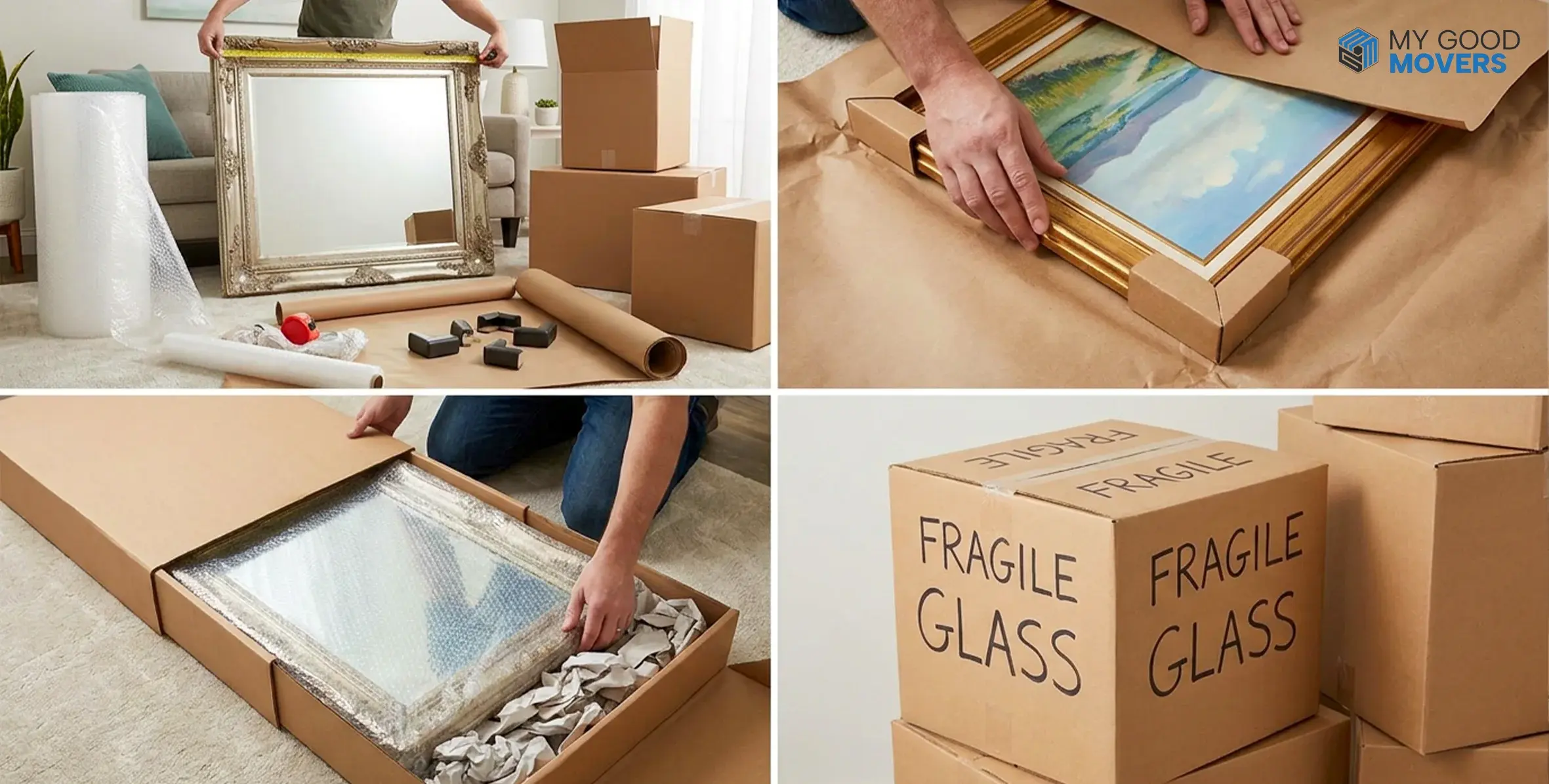
Some people switch to sustainable packaging materials but forget that fragile items still need proper protection. One thin layer of paper is usually not enough for glassware, dishes, mirrors, or décor.
Safer packing: Use kraft paper, honeycomb wrap, towels, old clothes, or soft fabrics to create layers.
Mistake #4: Ignoring Moisture Protection
Cardboard, paper, and other biodegradable packaging materials can weaken when they get wet. This matters if you are moving during rain or keeping items in a truck for a long time.
Better choice: Use reusable plastic bins for items that need extra protection from spills or humidity.
Mistake #5: Using Cheap Paper Tape
Paper tape is a good alternative to plastic tape, but low-quality tape can peel off if the box is heavy or the surface is dusty.
Better option: Use strong paper tape or water-activated paper tape for heavier boxes. Also, press the tape firmly onto clean cardboard so it seals properly.
Mistake #6: Buying More Supplies Than You Need
Even eco-friendly packaging creates waste when you overbuy. Many people purchase too many boxes, wraps, and fillers because they do not estimate their move properly.
Smarter move: Use our moving box calculator before buying supplies. It helps you estimate how many boxes you may need based on your home size, so you can avoid unnecessary waste and extra cost.