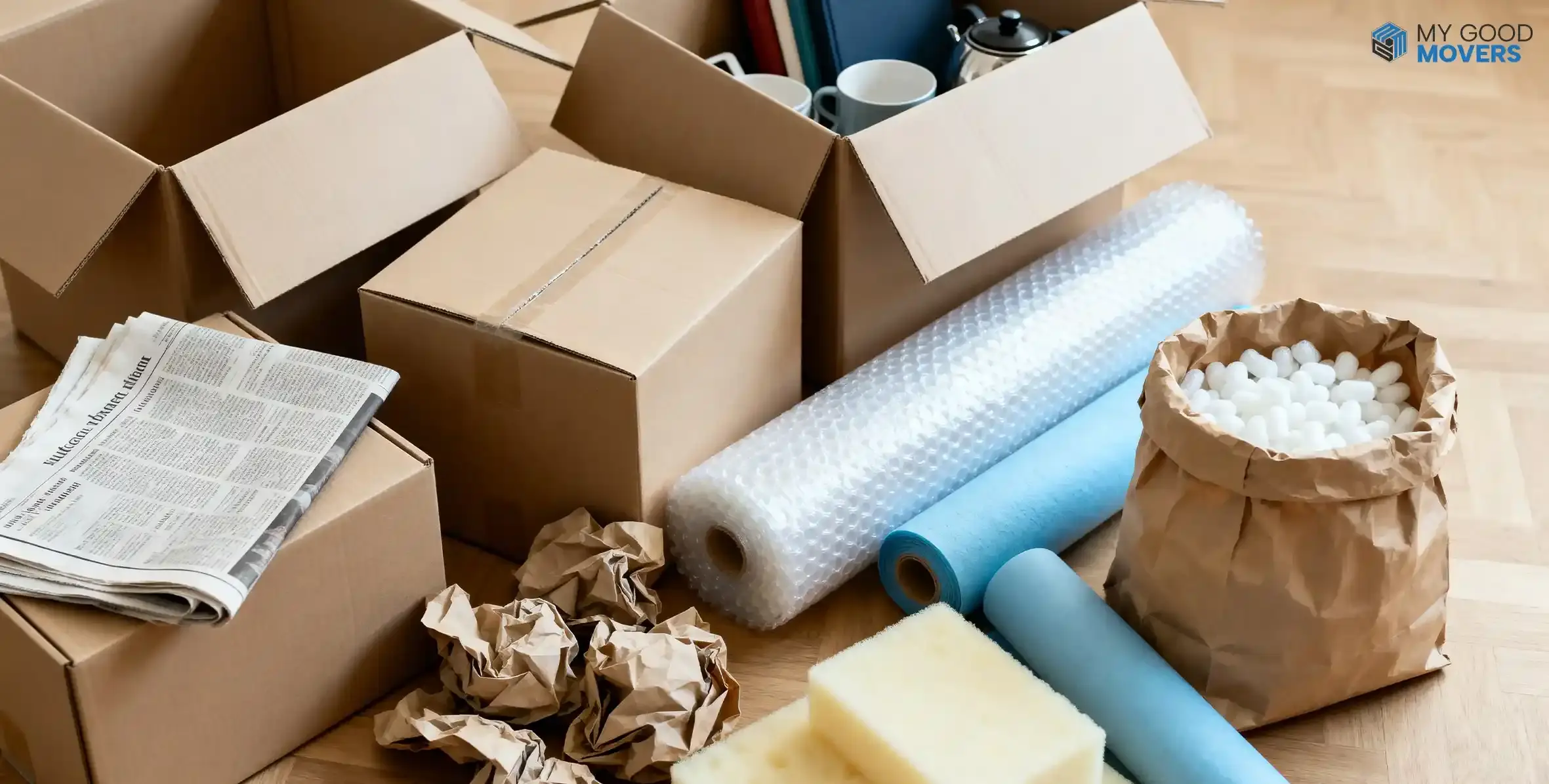




“Moving does not have to be expensive to be exhausting.” Most people feel that line the moment they start packing.
If you are reading this, chances are you are standing between two places in life, surrounded by piles of stuff, and quietly wondering how packing supplies became so costly.
According to industry estimates, the average local move can cost from $800 to $2,500, and a surprising chunk of that money goes into boxes, paper, and padding that are used once and thrown away. That is why so many people start searching for free packing supplies.
Every day, thousands of perfectly usable boxes and packing materials are discarded by stores, offices, and households around you. The challenge is not availability. The challenge is knowing where to look and what actually works. When people search for packing supplies near me, they are not just looking for boxes. They are looking for a smarter way to move without wasting money or time.
Let’s discuss practical places to find free packing supplies, explain what is worth picking up, and help you avoid common mistakes that create more stress instead of less.
What Counts as Free Packing Supplies
Below is a clear table that shows what usually counts as free and why people use them for packing.
| Packing Supply | Why It Counts as Free Packing |
|---|---|
| Cardboard boxes | Stores receive inventory daily and discard boxes once shelves are stocked. These become free cardboard boxes that are still strong and usable. |
| Small and medium boxes | Liquor stores, pharmacies, and offices regularly throw these away, making them ideal free packing boxes for heavy items. |
| Packing paper | Retailers and offices discard clean wrapping paper, flyers, and unused print paper that work as free packing paper. |
| Old newspapers | Many households and offices still recycle newspapers, which answers your question of where to get old newspapers for packing. |
| Paper bags | Grocery and retail paper bags can be crumpled to fill empty spaces and add cushioning. |
| Office printer paper | Misprints and outdated paperwork can be reused as packing paper for moving fragile items. |
| Towels and linens | Items you already own reduce the need to buy padding and protect fragile belongings well. |
| Clothing | Clothes act as shock absorbers for glassware and décor and cost nothing extra. |
| Reusable shopping bags | These work well for books, pantry items, and small household goods. |
| Cardboard dividers | Found inside liquor or wine boxes, useful for separating glass items. |
What you usually won’t get for free and why
Some packing supplies are rarely free because they are designed to be single-use or expensive to replace.
Here is a list so you know what not to waste time chasing.
- Bubble wrap: It is purchased in bulk and reused by businesses, so they rarely give it away.
- Packing tape: It is a consumable item, and once used, it cannot be reused.
- Stretch wrap or shrink wrap: Mostly used by warehouses and movers, and not something businesses discard.
- Wardrobe boxes: These are specialty boxes with built-in hanging rods and are expensive to manufacture.
- TV and appliance boxes: These are designed for specific items and usually resold or reused.
- Foam peanuts: Businesses either reuse them or dispose of them in sealed bags for recycling.
- Waterproof or plastic moving bins: These are durable assets, not disposable packaging.
Fastest Ways to Find Free Packing Supplies Locally
When time is short and moving day is getting closer, the last thing you want is to drive around guessing. Finding free packing supplies quickly is less about luck and more about timing and approach.
The fastest method is to focus on places that receive inventory daily and clear packaging regularly. Grocery stores, liquor stores, pharmacies, offices, and small retail shops are at the top of that list.
A quick visit or a polite call asking, “Do you have any boxes you are getting rid of today?” works far better than randomly checking dumpsters.
Another fast option is local online communities. Neighborhood groups and free-item listings have people who recently moved and want the boxes gone immediately. These are usually clean, already broken down, and ready for pickup the same day.
Simple Rule to Remember: “Go where packaging leaves faster than customers arrive.” That mindset alone saves hours.
Best times and days to search
Timing can make the difference between finding five boxes and finding fifty.
Here is what usually works best:
- Early mornings are ideal for grocery and retail stores. Shelves are stocked overnight, and boxes are cleared out before the store gets busy.
- Midweek days, especially Tuesday through Thursday, are better than weekends. Stores have regular deliveries, and staff have more time to help.
- End of business hours work well for offices and small shops, since packaging is cleared out before closing.
- End of the month is a strong window. Many people move around lease dates, which means more leftover boxes are available for free.
How many boxes to collect for common home sizes
One of the biggest mistakes people make is collecting too many or too few boxes. You do not need to guess. There are realistic ranges that work for most homes.
Here is a simple guideline:
- Studio or one-bedroom apartment: Around 20 to 30 boxes, mostly small and medium sizes.
- Two-bedroom home: Roughly 35 to 50 boxes, with a mix of medium and a few large boxes.
- Three-bedroom home: About 60 to 75 boxes, plus extra packing paper and padding.
- Four-bedroom or larger home: 90 or more boxes, depending on storage areas and furniture.
If you want more accuracy, many people use our moving box calculator to avoid collecting supplies they do not actually need.
Where to Get Free Packing Supplies
When someone asks, “Where to get free packing supplies,” what they actually mean is, “Tell me exactly where to go, what to ask for, and how to not waste my time.”
Local stores
Local stores are your fastest and most reliable option because packaging moves through them constantly.
Grocery and supermarket stock rooms
Grocery stores unpack inventory daily. Produce, dairy, and dry goods arrive in thick cardboard boxes that are designed to hold weight and moisture. These boxes are usually broken down the same day.
What to do:
- Visit early morning or ask for the stock manager.
- Say something simple like, “I am moving and wanted to check if you have boxes you are throwing away today.”
Liquor and wine stores
These stores are one of the best-kept secrets for movers. Liquor boxes are small, strong, and often come with built-in dividers.
Why they are valuable:
- Perfect for glasses, bottles, pantry items, and décor.
- Easy to stack and less likely to break.
If someone tells you, “Liquor boxes are better than moving boxes,” they are not exaggerating.
Big-box retailers and department stores
Stores like Walmart, Target, or Costco receive shipments on pallets every day. Their boxes are larger and flatter.
Best used for:
- Bedding, lamps, shoes, and lightweight bulky items.
- Layering with packing paper or towels for protection.
Pharmacies and convenience stores
These stores receive smaller shipments, but very frequently. Their boxes are clean and easy to carry.
They are ideal for:
- Bathroom items
- Pantry goods
- Books and documents
Coffee shops, bakeries, and cafés
These places receive boxes for cups, syrups, beans, and baking supplies.
Why they work:
- Boxes are sturdy and uniform.
- Less competition since most people do not think to ask here.
A quick “Do you have any boxes you are tossing today?” often works.
Bookstores and office supply stores
Bookstores receive heavy shipments of books, which means strong boxes. Office supply stores often discard printer paper, boxes, and unused paper.
Bonus: You may find free packing paper or excess printer sheets that work perfectly as packing paper for moving.
Electronics and appliance stores
While large TV boxes are not always free, smaller electronics packaging often is.
Good for:
- Monitors, printers, kitchen appliances, and cables.
- Extra cardboard inserts that add protection.
Ask what is being discarded, not what you want specifically.
Furniture and home goods stores
These stores receive furniture wrapped in thick cardboard sheets and corner protectors.
Best for:
- Mirrors
- Frames
- Artwork
- Odd-shaped items
Auto parts and hardware stores
Auto parts and hardware stores use reinforced boxes to hold metal and tools.
Ideal for:
- Garage items
- Tools
- Heavy household goods
Community and online places
If you want efficiency and less driving, community-based options are incredibly effective.
Local “free stuff” marketplace listings
Platforms like Facebook Marketplace, Craigslist (Free section), and Nextdoor often have people giving away boxes after moving.
Why this works:
- Boxes are usually already broken down.
- Pickup is fast and local.
Search terms like “moving boxes” or “free boxes” bring quick results.
Neighborhood and community groups
Local Facebook groups or neighborhood forums are powerful. A single post saying you are moving often gets multiple responses.
People genuinely want the boxes gone, and you save them a trip to the recycling center.
Office buildings and business parks
Offices receive frequent shipments of supplies and equipment.
What you can find:
- Strong printer paper boxes
- Excess paper that works as packing paper
- Clean, uniform boxes
Universities, schools, and dorm move-out periods
During end-of-semester move-outs, students leave behind large amounts of boxes and packing materials.
If your move aligns with this period, you can collect supplies quickly and in large quantities.
Recycling centers and cardboard drop-off areas
Some recycling centers allow people to take boxes before processing.
Important rules:
- Always check posted signs or ask staff.
- Do not take boxes from restricted areas.
Moving-related sources
These are not guaranteed, but when they work, they work very well.
Moving companies
Some movers have leftover boxes from completed jobs or returns. While they do not advertise this, asking politely can help.
You can search for the best packing and moving companies and call to ask if they have used boxes available.
Storage facilities and self-storage offices
Storage centers receive shipments of boxes and packing materials.
They may:
- Give away used boxes
- Offer supplies at very low cost, which helps if you need cheap packing materials.
Real estate offices and apartment leasing offices
These offices deal with move-ins and move-outs constantly.
They know:
- Who just moved and has boxes
- Where leftover supplies are stored
Sometimes, they already have a stack sitting in a back room.
Free Packing Materials Beyond Boxes
Boxes are only one part of packing. What actually keeps your belongings safe is what goes inside them.
Below are clear, quick pointers so you immediately know where to get each material.
Where to get free packing paper
- Offices and corporate buildings (discarded printer paper)
- Bookstores and office supply stores (excess wrapping paper)
- Newspapers and print shops
- Schools and libraries (outdated handouts)
- Recycling centers and paper drop-off areas
This is where most people find free packing paper and packing paper for moving.
Where to get free bubble wrap and foam
- Electronics stores (leftover packaging inserts)
- Furniture and home goods stores
- Appliance stores
- Local buy-and-sell or free-item marketplaces
- Moving company leftovers from recent jobs
These places are your best bet when searching for protective materials without buying new ones.
Where to get free padding (towels, linens, clothing)
- Your own home (towels, blankets, bedsheets)
- Seasonal clothing storage
- Guest rooms and linen closets
- Reusable tote bags and backpacks
Using what you already own reduces the need for extra packing materials and keeps items well-protected.
Where to get dividers for glassware and dishes
- Liquor and wine stores
- Restaurant supply stores
- Office kitchens and breakrooms
- Appliance and kitchenware stores
Liquor stores, in particular, are one of the easiest places to find sturdy dividers designed to protect glass.
How to Check If Free Boxes Are Strong Enough
Before you get excited and load up your car with free packing supplies, do this quick check. It takes a minute per box, and it can save you from a box tearing open right when you are carrying it down the stairs.
Step 1: Start with the “dry and clean” check
Pick the box up and run your hand along the bottom and corners.
- If the cardboard feels soft, wavy, or spongy, it has been exposed to moisture.
- If you see water stains, grease marks, or food residue, skip it.
A box can look fine but still be weak if moisture has already broken down the fibers.
Step 2: Look closely at the corners and seams
Corners and seams carry the load. If they are damaged, the box fails first.
Check for:
- Split edges
- Torn corners
- Pulling or separation where the flaps meet
- Old tape that has ripped the cardboard
If the corners are stressed or crushed, the box will not hold weight well, even if the sides look okay.
Step 3: Do the “press test” on the side panels
Place your palm on one side and press firmly.
A good box will feel solid and bounce back.
A weak box will bend easily, crease, or feel like it is about to collapse.
If you can easily cave in the side with one push, do not use it for anything heavy. At best, it can be used for light items like pillows or blankets.
Step 4: Check the bottom
Flip the box over and inspect the bottom flaps. This is where failure happens most often.
What you want:
- Flat, intact flaps with no tears
- Clean folds that still hold shape
- Strong overlap where the flaps meet
What to avoid:
- A bottom that looks bowed or uneven
- Flaps that have been creased too many times
- Rips along the fold lines
Step 5: Match box strength to the job
Not all free packing boxes are meant for all items. Even a good box can fail if you overload it.
Use this simple rule:
- Small sturdy boxes for books, tools, and canned food
- Medium boxes for kitchen items, décor, and small appliances
- Large boxes are only for light things like bedding and clothing
Step 6: Smell the box
This sounds obvious, but people ignore it and regret it later.
Avoid boxes that smell like:
- Smoke
- Mold
- Strong food odors
- Chemicals
Smells get trapped, especially once the box is sealed and stored. If it smells bad now, it will smell worse after a few days of being packed.
Step 7: Quick safety scan before bringing it into your home
Especially when boxes come from stock rooms or recycling areas, do a quick look inside.
Avoid any box with:
- Bugs or droppings
- Powdery residue
- Sticky patches
- Dark specks in corners
If you see anything that makes you hesitate, do not bring it inside. It is not worth the risk.
Signs a Box is Safe to Use
Here is what “good” usually looks like:
- Cardboard feels dry, firm, and crisp
- Corners are sharp, not crushed
- Side panels resist pressure and hold shape
- Bottom flaps are intact with clean folds
- No stains, no strong odors, no residue
When to Avoid a Box
Skip it if you notice any of the following:
- Moisture damage or soft spots
- Grease stains or food residue
- Torn seams, crushed corners, or deep creases
- Musty smell, smoke smell, or chemical smell
- Evidence of pests or dirt buildup
Rules, Etiquette, and Permission When Taking Boxes
Finding free packing supplies is not about grabbing whatever you see. It is about knowing what is actually available to take and how to ask without making things awkward.
When you handle this the right way, people are far more willing to help, and you avoid uncomfortable situations.
What you can take vs what you shouldn’t
Just because a box is sitting somewhere does not automatically mean it is free.
What you can usually take
- Boxes that are already broken down and stacked near trash or recycling areas
- Packaging is clearly placed outside or marked for disposal
- Boxes offered directly by store staff
- Boxes listed in the local community or free-item groups
- Supplies handed over by offices, neighbors, or recent movers
What you should not take
- Boxes still holding merchandise or returns
- Boxes inside the stock rooms without permission
- Boxes marked for recycling but located in restricted or staff-only areas
- Branded or specialty boxes that staff clearly plan to reuse
- Anything locked inside dumpsters or compactors
How to ask store staff the right way
Asking the right way makes all the difference. Most employees are not annoyed by the request. They just need to know what you are asking and when.
Here is what usually works best:
- Be polite and direct.
- Ask during slower hours, not during rush times.
- Speak to a floor employee or the customer service desk first.
A simple approach sounds like this: “Hi, I am moving and wanted to ask if you have any boxes you are throwing away today.”
That one sentence is clear, respectful, and easy to say yes to.
If they say no, thank them and move on. If they say yes, ask when and where to pick them up so you are not in the way.
What to Do If You Can’t Find Free Packing Supplies Nearby
Sometimes, despite doing everything right, free supplies just are not available. Timing, location, or a tight moving window can make it harder.
If that happens, the key is not to panic or overspend. You still have smart options.
Option 1: Buy only what you truly need
Instead of buying full moving kits, focus on gaps.
- Packing tape, labels, and markers usually need to be purchased.
- Specialty boxes may be necessary for TVs or wardrobes.
Average costs:
- Packing tape: $3 to $6 per roll
- Standard moving boxes: $1.50 to $4 per box
- Specialty boxes: $10 to $25 each
Option 2: Look for low-cost local alternatives
If free options are unavailable, affordable does not mean expensive.
- Discount stores and home improvement stores often sell bulk boxes at lower prices.
- Storage facilities sometimes offer used boxes for a fraction of the cost.
- Local sellers often list leftover supplies at very low prices after moving.
Option 3: Use everyday household items creatively
When supplies are limited, what you already own matters more.
- Towels, blankets, and clothing replace padding.
- Laundry baskets and storage bins hold lightweight items.
- Suitcases work well for books and heavy belongings.
Option 4: Get help from professionals selectively
You do not always need full-service movers.
- Some of the best packing and moving companies offer partial packing or supply-only options.
- You can also ask movers if they sell or give away used boxes after jobs.