



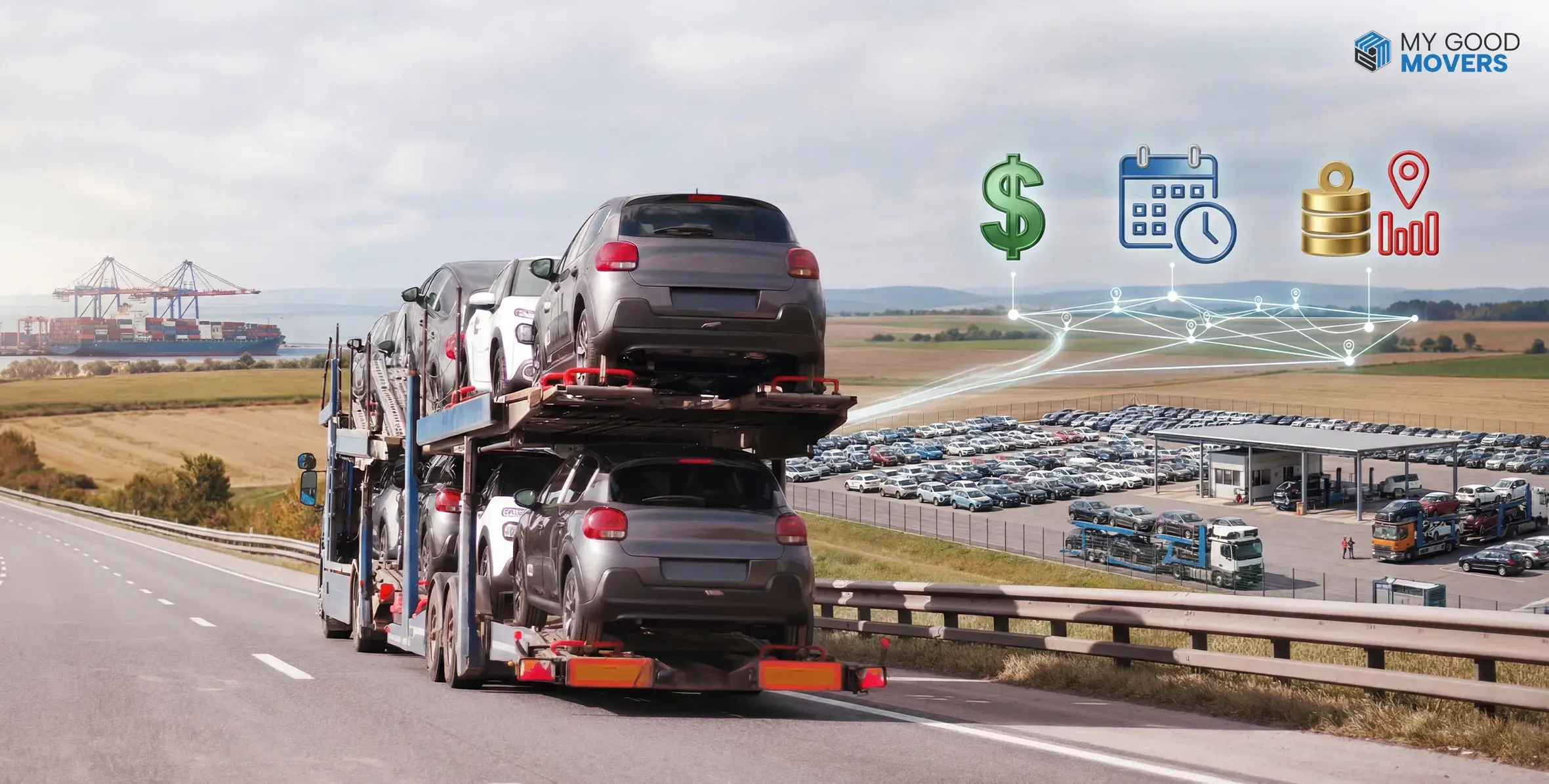
Quick Answer: The average cost to ship a car in the U.S. ranges from $482 to $1,927, depending on distance, vehicle type, transport method, and carrier availability. Short-distance routes cost less overall but have a higher per-mile rate, while cross-country shipments range between $1,487 and $2,214 using open transport. Enclosed shipping for luxury or classic vehicles can increase the final price by 35% to 60%.
Overview
One of the biggest surprises people face during relocation is how different the cost to ship a car can look for the exact same vehicle.
A person shipping his car from Texas to Florida might receive two quotes: one for $932 and another for $1,641. That naturally raises questions.
Why such a huge difference?
Most people are not overpaying because shipping is expensive. They overpay because they do not understand how pricing actually works.
Car shipping companies look at far more than just mileage. Route popularity, transport type, pickup flexibility, fuel costs, and even the size of your vehicle can change the final number.
That is why a compact sedan traveling across a busy interstate route may cost less than a short rural shipment in a remote area.
Let’s break down the real cost to ship a car using practical examples, expert insights, and simple explanations.
Average Cost to Ship a Car
Before most people book a shipment, the first thing they usually want to know is: “What should this actually cost me?” The answer depends on several moving parts because no two car shipping routes are priced exactly the same.
Typical shipping costs in 2026 look like this:
| Shipping Distance | Estimated Cost Range | Typical Transport Option | Best For |
|---|---|---|---|
| Under 500 miles | $418 – $723 | Open transport | Regional moves |
| 500 – 1,000 miles | $742 – $1,086 | Open transport | Interstate shipping |
| 1,000 – 2,000 miles | $1,124 – $1,638 | Open or enclosed | Long-distance relocation |
| Over 2,000 miles | $1,487 – $2,214 | Open or enclosed | Cross-country shipping |
Note: A shorter shipment does not always mean a lower rate per mile. Carriers still deal with loading, scheduling, insurance, fuel, and labor costs, no matter how short the route is.
Important: These are working estimates, not guaranteed quotes. Your actual number moves based on vehicle type, transport choice, pickup timing, and how busy carriers are on your route.
Car Shipping Cost by Distance and Per Mile
Distance affects every quote, but the relationship between mileage and pricing is not always straightforward. Many people assume longer shipments automatically cost more per mile. In reality, longer routes become cheaper on a per-mile basis.
This happens because carriers maximize efficiency on major interstate highways.
Cost to Ship a Car Under 500 Miles
Short-distance transport usually costs between $418 and $723.
The total amount looks manageable, but the cost per mile tends to be higher because fixed operating expenses still apply.
Typical per-mile rate is around: $1.12 to $1.74
Cost to Ship a Car 500 to 1,000 Miles
This range is extremely common for interstate relocation.
Typical pricing is around: $742 to $1,086
Average per-mile cost is around: $0.81 to $1.18
These routes offer the best balance between affordability and transport efficiency.
Popular examples include:
- Georgia to Texas
- Illinois to Florida
- Nevada to Colorado
Cost to Ship a Car 1,000 to 2,000 Miles
Long-distance vehicle transport usually costs between $1,124 and $1,638.
Per-mile pricing becomes lower because carriers can optimize fuel usage and trailer capacity more effectively.
Average delivery timeline is around: 4 to 7 days
Average per-mile rate is around: $0.67 to $0.93
This category commonly includes major relocation moves.
Cost to Ship a Car Over 2,000 Miles
Cross-country car shipping normally ranges from $1,487 to $2,214, depending on vehicle size and route demand.
Average delivery timeline is around: 7 to 10 days
Average per-mile cost is around: $0.61 to $0.82
Popular coast-to-coast routes usually move faster because carriers already operate there consistently.
Don’t Guess Your Moving Budget
See what people usually pay for different types of moves within the U.S. before you make your final decision.
How Much Does It Cost to Move in the USA?Main Factors That Affect Car Shipping Cost
Most pricing differences come down to a few important factors behind the scenes. Understanding these variables helps you compare quotes more confidently.
- Distance: Longer routes increase the total shipping cost, although the cost per mile usually becomes cheaper on major interstate highways.
- Pickup and Delivery Route: Popular city-to-city routes cost less because carriers already travel those highways regularly, while rural towns and remote areas may increase pricing.
- Vehicle Size and Weight: Larger vehicles like SUVs and pickup trucks take up more trailer space and increase fuel usage, which raises transport costs.
- Transport Type: Enclosed car transport costs more than open shipping because enclosed trailers carry fewer vehicles and offer additional protection.
- Vehicle Condition: Non-running vehicles usually cost more because carriers need special loading equipment, such as winches or forklifts.
- Season and Demand: Summer months and peak relocation seasons often bring higher prices due to increased shipping demand across the country.
- Pickup Flexibility: Flexible pickup dates can help lower costs because carriers can optimize scheduling more efficiently.
- Fuel Prices and Carrier Availability: Rising fuel prices and limited carrier availability can increase quotes, especially during busy seasons or on less common routes.
Open vs Enclosed Car Shipping Cost
When you compare open and enclosed shipping, do not think of it as just two different trailer types. Think of it as two different price levels.
Open transport is the lower-cost option. Enclosed transport is the higher-protection option.
That is the real difference.
Important Info:
If you are shipping a normal daily-use car, open transport usually makes more sense because it keeps the car shipping cost lower.
If you are shipping a luxury, exotic, classic, collector, or freshly restored vehicle, enclosed transport may be worth the higher price.
Enclosed shipping commonly costs 30% to 60% more than open transport for the same route.
Open Car Shipping Cost
Open transport is usually the most affordable way to move a vehicle because the carrier can load several cars on one trailer. Since more vehicles share the same trip, fuel, driver time, tolls, and operating costs are divided across more customers.
Open transport usually costs less because:
- The trailer can carry more vehicles at once.
- More open carriers are available across the country.
- Pickup windows are usually easier to arrange.
- Popular routes often have more carrier competition.
- It is the standard option for most regular vehicles.
Here is what the open transport cost usually looks like:
| Distance Type | Open Transport Cost Range | What This Means |
|---|---|---|
| Short distance, under 500 miles | $540 to $1,100 | The total price is lower, but the per-mile rate is higher because the carrier still has fixed costs. |
| Medium distance, 500 to 1,500 miles | $700 to $1,800 | This is where many state-to-state shipments fall, and the price depends heavily on route popularity. |
| Long distance, 1,500+ miles | $1,050 to $3,000+ | The total price is higher, but the per-mile cost usually becomes lower on longer routes. |
Open transport is usually the better fit when:
- You are shipping a standard daily-use vehicle.
- You want to keep the cost to ship a car reasonable.
- You are comfortable with normal outdoor exposure.
- You do not need premium-level protection.
- Your route is common or close to a major interstate.
- You want easier scheduling and more carrier options.
Enclosed Car Shipping Cost
Enclosed transport costs more because the trailer protects your vehicle inside a covered carrier. The vehicle is not exposed to open road conditions in the same way it would be on an open trailer.
“With enclosed transport, you are not just paying to move the vehicle. You are paying to lower the risk during the move.”
Here is how the enclosed cost usually compares with open shipping:
| Shipping Situation | Open Transport Cost | Enclosed Transport Cost | Extra Cost for Enclosed Shipping |
|---|---|---|---|
| Short-distance shipment, under 500 miles | $540 to $1,100 | $700 to $1,700 | Around $160 to $600 more |
| Medium-distance shipment, 500 to 1,500 miles | $700 to $1,800 | $900 to $2,800 | Around $200 to $1,000 more |
| Long-distance shipment, 1,500+ miles | $1,050 to $3,000+ | $1,400 to $4,800+ | Around $350 to $1,800+ more |
| Cross-country shipment | $1,000 to $1,500+ | $1,400 to $2,400+ | Around $400 to $900+ more |
Enclosed transport usually costs more because:
- The carrier carries fewer vehicles per trip.
- The trailer costs more to operate.
- There are fewer enclosed carriers available.
- Loading and unloading often takes more care.
- High-value vehicles may require more careful handling.
- The carrier may have higher insurance responsibilities.
Enclosed transport usually makes sense for:
- Luxury cars
- Exotic vehicles
- Classic cars
- Antique vehicles
- Collector cars
- Restored vehicles
- Custom show cars
- High-value sports cars
Open vs Enclosed Cost by Distance
Here is a simple way to compare both options:
| Shipping Distance | Open Transport Estimate | Enclosed Transport Estimate | Cost Difference |
|---|---|---|---|
| 500 miles | $650 to $900 | $1,000 to $1,300 | Enclosed may add $350 to $400+ |
| 1,000 miles | $650 to $800 | $1,000 to $1,200 | Enclosed may add $350 to $400+ |
| Cross-country route | $1,000 to $1,500+ | $1,400 to $2,400+ | Enclosed can add several hundred dollars or more |
Open vs Enclosed Cost Per Mile
If two companies give you quotes for the same route, one open and one enclosed, the enclosed quote will usually have a higher per-mile rate.
| Transport Type | Example Per-Mile Cost | Best For |
|---|---|---|
| Open transport | Around $1.66 per mile | Regular vehicles, budget-focused moves, standard relocation |
| Enclosed transport | Around $2.45 per mile | Luxury, classic, exotic, collector, or high-value vehicles |
Extra Costs That Can Affect Open and Enclosed Shipping
The transport type is important, but it is not the only thing that changes the quote. Some extra costs can apply to both open and enclosed shipping.
| Transport Type | Example Per-Mile Cost | Best For |
|---|---|---|
| Open transport | Around $1.66 per mile | Regular vehicles, budget-focused moves, standard relocation |
| Enclosed transport | Around $2.45 per mile | Luxury, classic, exotic, collector, or high-value vehicles |
What You Actually Pay For in Open vs Enclosed Shipping
With open transport, most of your money goes toward movement. With enclosed transport, more of your money goes toward protection.
| What You Pay For | Open Transport | Enclosed Transport |
|---|---|---|
| Vehicle movement | Included | Included |
| Carrier loading and unloading | Included | Included with more careful handling |
| Basic carrier insurance | Usually included | Usually included, sometimes with higher limits depending on the carrier |
| Weather and road exposure protection | Limited | Much stronger protection |
| Trailer availability | Higher | Lower |
| Scheduling flexibility | Usually better | Sometimes more limited |
| Price level | Lower | Higher |
Which Option Gives Better Value?
Here is the easiest way to decide:
| Your Situation | Better Value Option | Why |
|---|---|---|
| You are shipping a daily-use sedan | Open transport | The vehicle does not usually need premium protection. |
| You are shipping a family SUV | Open transport | You get a lower quote and enough protection for standard use. |
| You are moving on a tight budget | Open transport | It keeps the overall vehicle shipping cost lower. |
| You are shipping a luxury car | Enclosed transport | The higher price protects a higher-value vehicle. |
| You are shipping a classic or collector car | Enclosed transport | Small cosmetic damage can be costly or difficult to repair. |
| You are shipping a freshly restored car | Enclosed transport | The finish and condition are worth protecting. |
Want to Estimate Your Moving Cost Too?
Use our moving cost calculator to get a quick price estimate based on your move size, distance, and moving details.
Car Shipping Cost by Vehicle Type
Vehicle size quietly affects pricing more than many people expect. Larger vehicles reduce trailer capacity and increase fuel usage, which directly impacts carrier costs.
| Vehicle Type | Average Shipping Cost | Why Pricing Changes | Best Transport Option |
|---|---|---|---|
| Sedan | $523 – $1,286 | Smaller size and lighter weight help carriers fit more vehicles on the trailer | Open transport |
| SUV | $742 – $1,684 | A taller body and heavier weight increase fuel usage and trailer space | Open transport |
| Pickup Truck | $816 – $1,927 | Large dimensions, extra weight, lift kits, or oversized tires may require special arrangements | Open or oversized transport |
| Luxury or Classic Car | $1,346 – $2,918 | Higher-value vehicles usually need enclosed shipping and extra protection during transit | Enclosed transport |
| Non-Running Vehicle | An additional $173 – $482 added to the normal shipping price | Requires winches or special loading equipment because the vehicle cannot move on its own | Specialized carrier or assisted loading |
Always Disclose Upfront
If a carrier arrives and discovers your vehicle is different from what was described, a non-runner, a wider profile or a higher lift, they can add fees on the spot or refuse to load. Either scenario is worse than disclosing it from the start. Be specific when you request your quote.
Hidden Fees and Extra Charges to Watch For
Some car shipping quotes look cheap at first, but the final price can increase if certain conditions are not included in the original estimate.
| Hidden Fee or Extra Charge | Possible Added Cost | Why This Cost May Appear |
|---|---|---|
| Expedited pickup fee | $87 to $293 | You may pay more when you need the carrier to pick up your vehicle faster than the standard window. |
| Non-running vehicle fee | $129 to $487 | A vehicle that cannot drive onto the trailer may need a winch or special loading support. |
| Oversized vehicle fee | $116 to $438 | Larger trucks, lifted vehicles, or modified vehicles may take more trailer space and add weight. |
| Remote pickup or delivery fee | $142 to $529 | Rural or hard-to-access locations can require extra fuel, time, and route adjustment. |
| Failed pickup or missed appointment fee | $73 to $218 | This may apply if the vehicle is not ready or no one is available when the carrier arrives. |
| Storage fee | $34 to $96 per day | Storage may be charged if the vehicle cannot be delivered or picked up at the agreed time. |
| Top-load placement fee | $83 to $241 | Some open carrier customers pay extra to place the vehicle on the upper deck for less exposure to road debris. |
| Extra insurance coverage | $58 to $377 | Some customers buy additional coverage when shipping high-value vehicles. |
| Fuel surcharge | $41 to $263 | Some companies add a fuel-related charge when diesel prices rise or routes become more expensive. |
| Cancellation fee | $69 to $247 | This may apply if you cancel after the carrier has already been assigned. |
How Car Shipping Quotes Are Calculated
Many users assume quotes are generated instantly using only mileage. In reality, shipping companies evaluate several moving parts before finalizing pricing.
Here's exactly how that math works:
✅ Before You Book: Check Every Item
- Is the quote an estimate or a price-locked guarantee?
- What fees are included, and what will be charged at pickup or delivery?
- Is insurance coverage included, and what is the coverage limit per vehicle?
- Is this company a broker (books carriers on your behalf) or a direct carrier?
- Are cancellation and refund terms written clearly in the contract?
- Is the pickup window confirmed in writing, not just mentioned verbally?
- Do you have a direct contact number for the assigned carrier?