




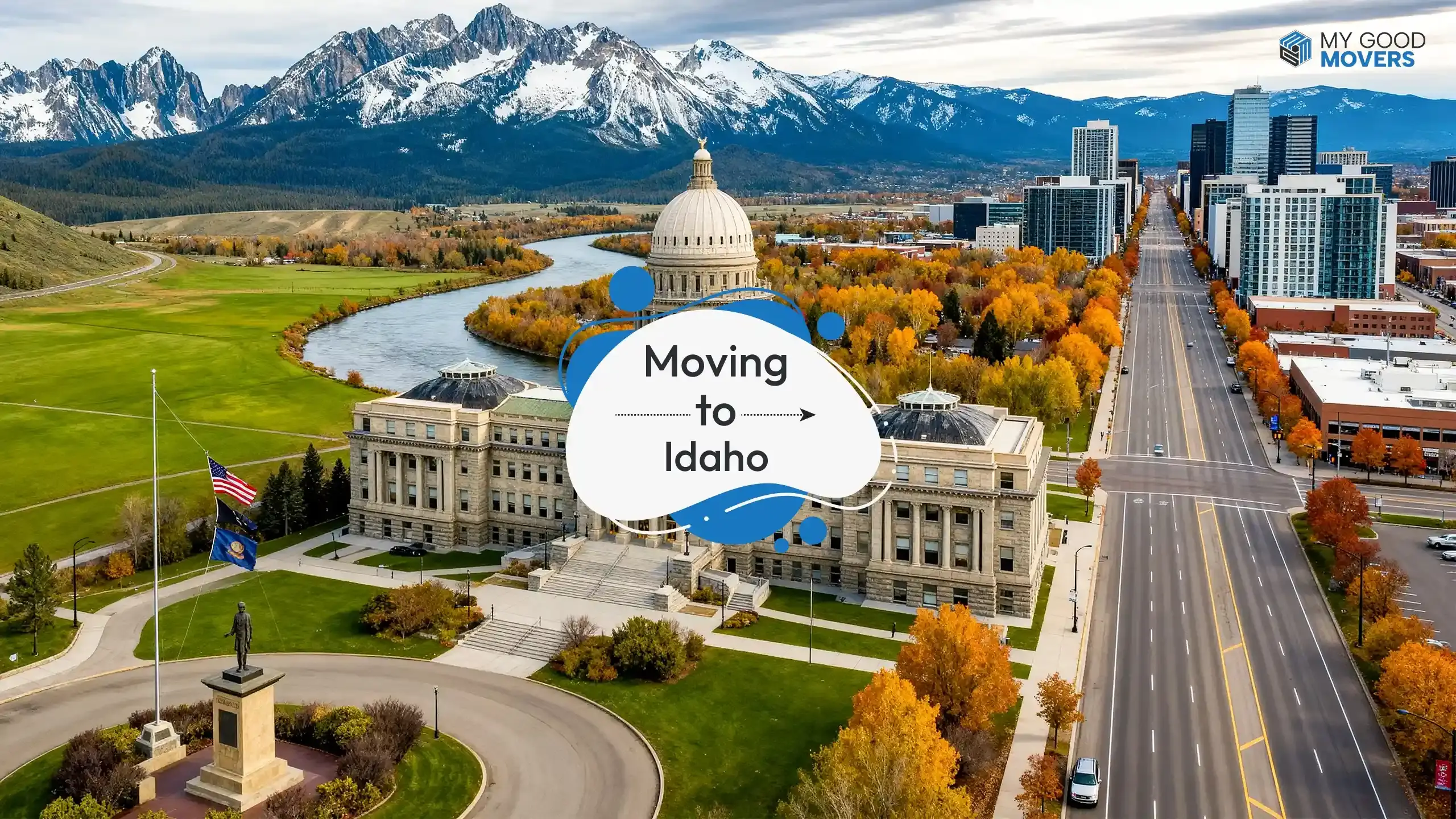
Idaho offers a quieter lifestyle and plenty of outdoor space, but the cost of everyday life deserves a closer look.
The state is known for its mountains, open landscapes, and growing communities. Still, moving to Idaho in 2026 involves more than finding a beautiful place to live. Housing prices, job opportunities, winter weather, and monthly expenses all affect how comfortable your life will be.
A fresh start feels much better when your new home fits your budget, work, and daily routine.
The cost of living in Idaho and local job opportunities deserve careful attention before you decide. These steps for moving to another state will help you prepare once you've weighed your options.
Idaho might already be on your list, but the right place depends on your budget, job opportunities, and lifestyle. These factors also matter when deciding where to move in the USA.
- Moving to Idaho at a Glance
- Idaho Relocation Quick Facts
- Pros and Cons of Living in Idaho
- Idaho Population and Migration Trends
- Best Places to Live in Idaho
- Compare Idaho's Major Cities
- Cost of Living in Idaho
- Taxes and Insurance in Idaho
- Where Are the Best Job Opportunities in Idaho?
- Crime and Safety in Idaho
- Idaho Weather and Climate
- Healthcare in Idaho
- Schools and Colleges in Idaho
- Transportation and Commuting in Idaho
- Is Idaho Right for Your Situation?
- How Much Does It Cost to Move to Idaho?
- Best Moving Companies for Your Move to Idaho
- FAQs
- Our Research and Data Process
Moving to Idaho at a Glance
Is Idaho a Good Place to Live?
Yes, Idaho offers beautiful natural surroundings, outdoor activities, and quieter communities. It's a good place for people who value space and a relaxed lifestyle, though housing affordability and access to services differ across the state.
Is Moving to Idaho Worth It?
Yes, especially if you have a steady income and prefer a quieter lifestyle. The move makes more financial sense when your earnings cover housing, transportation, and regular expenses while leaving enough money for savings.
Who Is Idaho Best Suited For?
Families, remote workers, retirees, and outdoor enthusiasts who appreciate open spaces, family-friendly communities, and easy access to nature. People with stable jobs who want a less crowded environment will also feel at home.
Who May Not Enjoy Living in Idaho?
People who prefer mild winters, extensive public transportation, or a busy nightlife scene will also feel at home. Rural communities also have longer travel distances and fewer options for specialized healthcare, shopping, and entertainment.
Idaho Relocation Quick Facts
| Category | Idaho Quick Facts |
|---|---|
| Capital | Boise |
| Largest City | Boise |
| Major Cities | Boise, Meridian, Nampa, Idaho Falls, Pocatello, Coeur d'Alene |
| Population | 2,029,733 |
| Population Growth | 10.4% since 2020 |
| Time Zone | Mountain Time in most areas; Pacific Time in northern Idaho |
| Climate Type | Cold winters, warm summers, and noticeable regional differences |
| Median Household Income | $77,800/year |
| Basic Living Cost | $40,615/year after taxes |
| Median Home Value | $418,600 |
| Median Gross Rent | $1,238/month |
| State Income Tax | 5.3% flat rate |
| State Sales Tax | 6% statewide, with some local taxes |
Pros and Cons of Living in Idaho
Pros
- Plenty of outdoor activities, like hiking, fishing, skiing, and camping.
- Job opportunities in healthcare, technology, agriculture, and manufacturing.
- Access to mountains, lakes, forests, and open spaces.
- Quieter communities and less congestion outside major population centers.
- Lower property tax burdens than many other states.
- Public universities, community colleges, and career training programs.
- A choice of suburban, small-town, and rural lifestyles.
Cons
- Cold, snowy winters make travel and outdoor work harder.
- Wages in some industries struggle to keep up with housing costs.
- Wildfire smoke affects air quality during parts of the year.
- Public transportation is limited, so most residents rely on cars.
- Rising home prices make popular areas less affordable.
- Rural communities have fewer specialists and healthcare facilities.
- Shopping, entertainment, and employment options are limited in remote areas.
Idaho Population and Migration Trends
More Americans are moving to Idaho to find a new place to live. From 2020 to 2025, the state's population grew by nearly 191,000 people. Most of the recent growth was in southwestern Idaho.
How Many People Live in Idaho?
Best Places to Live in Idaho
Idaho offers a range of living options for families, professionals, retirees, and students. These picks consider jobs, household income, schools, housing, and lifestyle to help you find a place that fits your needs.
Boise
Idaho's largest job market, outdoor recreation, and a median household income of $83,904.
Meridian
Schools, parks, and shopping, with population growth of 21.4% since 2020.
Eagle
Quiet neighborhoods and parks, with a median household income of $122,894.
Coeur d'Alene
Lakeside recreation, access to healthcare, and a lively downtown.
Idaho Falls
Healthcare, energy research, manufacturing, and family amenities.
Twin Falls
Agriculture, food processing, healthcare, and outdoor recreation.
Compare Idaho's Major Cities
| City | Population | Growth | Basic Monthly Cost* | Median Home Value | Median Rent | Median HH Income |
|---|---|---|---|---|---|---|
| Boise | 238.4K | +0.3% | $3,566 | $484.8K | $1,446 | $83,904 |
| Meridian | 143.0K | +2.4% | $3,566 | $531.6K | $1,805 | $100,795 |
| Nampa | 120.4K | +2.4% | $3,394 | $370.8K | $1,420 | $74,279 |
| Caldwell | 76.6K | +4.7% | $3,394 | $367.3K | $1,264 | $73,058 |
| Idaho Falls | 71.8K | +3.2% | $3,348 | $335.5K | $1,075 | $73,110 |
| Pocatello | 58.8K | +0.3% | $3,084 | $271.0K | $948 | $60,418 |
| Coeur d'Alene | 58.2K | +1.4% | $3,434 | $483.5K | $1,468 | $72,338 |
| Twin Falls | 56.2K | +1.2% | $3,232 | $321.3K | $1,082 | $61,205 |
| Post Falls | 46.7K | +2.0% | $3,434 | $477.4K | $1,469 | $82,183 |
| Rexburg | 40.3K | 0.0% | Not verified | $395.1K | $1,004 | $50,617 |
Cost of Living in Idaho
The latest BEA data puts Idaho's price index at 95.5, which means everyday prices are 4.5% below the U.S. average.
Housing Costs
Idaho's housing market has become more expensive, especially for buyers seeking homes near major employment centers. In 2026, the typical home value reached $476,754, up 2.2% from the previous year.
Idaho home values continue to rise.
Home values increased despite Idaho's overall living costs remaining below the national average. They have risen 2.2% from the previous year.
| Housing Expense | Latest Cost |
|---|---|
| Typical home value | $476,754 |
| Median sale price | $493,582 |
Everyday Monthly Costs
Idaho vs. the U.S. Average
Taxes and Insurance in Idaho
The state's tax system includes a credit for eligible grocery purchases and property tax relief for qualifying homeowners.
| Expense | Idaho Rate or Cost |
|---|---|
| State income tax | 5.3% flat rate |
| State sales tax | 6% statewide |
| Grocery tax | 6% |
| Homeowner's exemption | 50% of qualifying home and land value |
| Homeowners insurance | $183/month |
Idaho's Overall Tax Burden Compared With Nearby States
Idaho ranks among the region's lower-tax states.
| State | Overall Tax Burden | Property | Income | Sales & Excise | Difference vs. Idaho | Per $100K Income |
|---|---|---|---|---|---|---|
| Idaho | 7.04% | 1.92% | 1.84% | 3.29% | Baseline | Baseline |
| Wyoming | 6.70% | 3.42% | 0% | 3.28% | -0.34 pts | -$340 |
| Montana | 7.29% | 3.04% | 3.05% | 1.20% | +0.25 pts | +$250 |
| Nevada | 8.37% | 2.09% | 0% | 6.28% | +1.33 pts | +$1,330 |
| Washington | 8.47% | 2.47% | 0.13% | 5.87% | +1.43 pts | +$1,430 |
| Utah | 8.87% | 2.21% | 2.92% | 3.73% | +1.83 pts | +$1,830 |
| Oregon | 9.46% | 2.96% | 4.76% | 1.74% | +2.42 pts | +$2,420 |
How Expensive Is It to Live in Idaho?
A steady paycheck makes relocation easier, but your household's needs depend heavily on housing and how many people earn income.
| Household | Living Wage | Basic Monthly Budget | Annual Income Before Taxes |
|---|---|---|---|
| Single adult | $23.60/hour | $3,385 | $49,091 |
| Couple, both working | $16.47/hour each | $4,956 | $68,523 combined |
| Family of four, two working parents | $27.17/hour each | $8,203 | $113,041 combined |
Where Are the Best Job Opportunities in Idaho?
A job offer is a good reason to consider Idaho, but the salary needs to match the cost of living.
Idaho's Top Career Hubs
Top career hubs by pay. Average annual pay across all occupations, by metro area.
| Career Hub | Strong Career Areas | Average Annual Pay |
|---|---|---|
| Boise City | Technology, finance, healthcare | $64,530 |
| Idaho Falls | Engineering, energy research, healthcare | $61,160 |
| Coeur d'Alene | Healthcare, construction, tourism | $60,060 |
| Lewiston | Manufacturing, healthcare, transportation | $59,120 |
| Pocatello | Education, healthcare, manufacturing | $55,170 |
| Twin Falls | Food processing, agriculture, healthcare | $53,580 |
Which City Fits Your Career?
| Choose | When You Work In |
|---|---|
| Boise | Technology, finance, government, or business services |
| Idaho Falls | Engineering, energy research, or healthcare |
| Coeur d'Alene | Healthcare, construction, or hospitality |
| Lewiston | Manufacturing, transportation, or skilled trades |
| Pocatello | Education, healthcare, or research |
| Twin Falls | Agriculture, food processing, or manufacturing |
Crime and Safety in Idaho
Safety is one of Idaho's stronger points. Reported crime is lower than the national average, which is reassuring for anyone planning a move.
Is Idaho a Safe Place to Live?
Yes. Idaho reported lower violent and property crime rates than the U.S. overall in 2024. Property crime was particularly low, though safety varies by community.
Idaho Violent and Property Crime Trends
The latest FBI figures show improvement across several major crime categories.
| Crime Measure | 2024 Rate per 100K | Change From 2023 | Compared With the U.S. |
|---|---|---|---|
| Violent crime | 231 | -4.1% | 35.8% lower |
| Property crime | 736 | -10.1% | 58.2% lower |
| Overall crime | 967 | -8.7% | Lower |
| Murder | 2 | -36.0% | Lower |
| Robbery | 7 | -25.5% | Lower |
| Burglary | 116 | -18.7% | Lower |
Safest Cities and Communities in Idaho
| Community | Violent Crime per 100K | Property Crime per 100K | 2024 Safety Snapshot |
|---|---|---|---|
| Moscow | 19 | 1,016 | Very low violent crime |
| Kimberly | 53 | 356 | Low violent and property crime |
| Preston | 64 | 382 | Both rates below Idaho averages |
| Rathdrum | 64 | 850 | Low violent crime |
| Rexburg | 70 | 523 | Both rates below Idaho averages |
Road Safety and Traffic Fatalities
Idaho's rural highways deserve extra attention.
Idaho Weather and Climate
Idaho doesn't have one type of weather statewide. Southern valleys have hot, dry summers, while northern Idaho and mountain communities experience wetter, snowier conditions.
Cool & Changeable
Rain, cool mornings, and late mountain snow are common.
Hot & Dry
Southern valleys get hot afternoons, while wildfire smoke sometimes affects air quality.
Crisp & Cooler
Comfortable daytime weather gives way to colder nights and early mountain snow.
Cold & Snowy
Snow and icy roads are common, with longer winter conditions at higher elevations.
What Else to Expect
| Weather Period | Typical Conditions | What to Expect |
|---|---|---|
| Snow | 10–20 inches in lowlands; 100+ inches in mountains | Snowy winters and icy roads |
| Rainfall | 23.7 inches annually | Mostly November to May |
| Thunderstorms | May to August | Lightning, hail, and strong winds |
| Tornado season | Late spring to summer | Rare, mostly weak tornadoes |
| Hurricane risk | No direct hurricane risk | Occasional tropical-remnant rainfall |
Which Parts of Idaho Face the Greatest Weather Risks?
- Northern and central Idaho, especially mountain communities: Face heavy snowfall, icy roads, winter storms, and wildfire risks during dry periods.
- Southern Idaho: Experiences hotter, drier summers, wildfire smoke, and occasional flash flooding. Areas near rivers also face flooding during rapid snowmelt.
Healthcare in Idaho
Healthcare in Idaho is easier to access near larger population centers, where hospitals offer emergency treatment, surgery, maternity care, and specialist services. The situation changes in rural Idaho, with fewer nearby specialists and longer distances between medical facilities.
Best Hospitals and Medical Centers
Idaho has established medical centers for heart care, cancer treatment, trauma services, and other specialized needs.
| Rank | Hospital | City | Key Strength |
|---|---|---|---|
| #1 | St. Luke's Boise Medical Center | Boise | Heart care, surgery, specialty services |
| #2 | Kootenai Health | Coeur d'Alene | Cardiac care, cancer treatment |
| #2 | Portneuf Medical Group | Pocatello | Heart care, orthopedics, emergency services |
| #4 | Eastern Idaho Regional Medical Center (EIRMC) | Idaho Falls | Emergency care, surgery, neonatal care |
| #4 | Saint Alphonsus Regional Medical Center | Boise | Trauma, heart care, surgery |
Rural Healthcare Availability
Idaho's smaller communities don't guarantee a hospital close to home. Critical Access Hospitals provide essential services in rural areas, but complex procedures require travel to larger medical centers.
| Rural Healthcare Measure | Latest Published Figure |
|---|---|
| Rural counties | 79.5% |
| Rural residents | 509,676 |
| Rural hospitals | 27 |
| Counties without a hospital | 11 of 44 |
| Critical Access Hospitals | 26 |
| Rural Emergency Hospitals | 1 |
| Rural Health Clinics | 57 |
| Federally Qualified Health Center sites outside large urban areas | 54 |
Schools and Colleges in Idaho
For families with school-age children, the right district matters just as much as the right home. Idaho's public schools differ in academic performance, classroom resources, and available programs.
Best-Rated School Districts
These districts rank in the top five in Niche's latest Idaho district rankings, which consider academics, teacher quality, student experiences, and other factors.
| Idaho Rank | School District | Area | Notable Feature |
|---|---|---|---|
| #1 | Troy School District | Troy | Small district, strong academic performance |
| #2 | West Side Joint School District | Dayton | Small-town schools and strong graduation results |
| #3 | Moscow School District | Moscow | Academic programs and university-town resources |
| #4 | Cottonwood Joint School District | Cottonwood | Strong student test performance |
| #5 | Lakeland School District | Rathdrum area | North Idaho schools and extracurricular options |
Idaho Colleges and Universities
Idaho offers public research universities, regional institutions, and community colleges that provide both academic degrees and career training.
| University / College | Location | Known For |
|---|---|---|
| Boise State University | Boise | Business, engineering, computer science |
| University of Idaho | Moscow | Agriculture, engineering, research |
| Idaho State University | Pocatello | Healthcare, pharmacy, science |
| Lewis-Clark State College | Lewiston | Nursing, education, business |
| College of Southern Idaho | Twin Falls | Career training, technical programs |
| College of Western Idaho | Nampa | Workforce training, transfer degrees |
Transportation and Commuting in Idaho
Daily travel in Idaho looks different from life in a large metropolitan area. Commutes are generally shorter than the national average, but public transportation covers only certain communities.
| Transportation Area | Idaho Details |
|---|---|
| Main interstates | I-15, I-84, I-86, I-90, I-184 |
| Public transportation | Valley Regional Transit, Pocatello Regional Transit, Citylink, GIFT On-Demand |
| Walking and cycling | Most practical near downtown areas |
| Busiest airport | Boise Airport (BOI) |
| Level 2 charging ports | 433 |
| DC fast-charging ports | 322 |
Do You Need a Car in Idaho?
Yes, a car is the most practical choice for most Idaho residents. Public buses and on-demand transit serve selected communities, but they don't cover every neighborhood or rural area.
Is Idaho Right for Your Situation?
Moving to Idaho With a Family
Quiet neighborhoods, local parks, and outdoor activities give families more ways to spend time together. Children have space to play, and weekends bring hiking, camping, and trips to beautiful nearby lakes.
Moving to Idaho as a Young Professional
Jobs in healthcare, technology, and skilled trades offer young professionals clear career paths. Less traffic in smaller communities leaves more free time for friends, fitness, hiking, and other activities after work.
Moving to Idaho as a Single Person
A relaxed lifestyle and easy access to nature suit people who enjoy their own space. Hiking groups, sports clubs, and local events offer simple ways to meet people and make friends.
Moving to Idaho for Retirement
Peaceful communities, scenic views, and outdoor recreation make retirement enjoyable. Fishing, walking, and local activities keep days interesting, while Idaho's exemption for Social Security benefits helps retirees manage their retirement money.
Moving to Idaho for College
Public universities, community colleges, and technical programs offer options for different career goals. Campus clubs, student events, and nearby outdoor activities make it easy to meet people and enjoy college life.
How Much Does It Cost to Move to Idaho?
Moving to Idaho from another state usually costs around $2,000 to over $9,000 for a 2–3-bedroom home with full-service movers.
The distance, amount of belongings, moving date, and extra services you choose will make the biggest difference in your final price.
Estimated Moving Costs to Idaho
- Nearby State $3,151Utah to Idaho370 miles
- Mid-Distance Move $4,026California to Idaho750 miles
- Cross-Country Move $7,223Georgia to Idaho2,140 miles
Moving Costs by Service Type
You have a few options for handling your relocation. Professional movers handle loading and delivery, while a moving container leaves packing and loading to you.
A rental truck costs less upfront, but you handle the drive and additional travel expenses.
| Moving Service | Estimated Cost for a 2–3-Bedroom Move | What You're Paying For | Detailed Cost Guide |
|---|---|---|---|
| Full-Service Movers | $5,911 | Professional loading, transportation, and unloading | Full-Service Moving Costs |
| Moving Containers | $2,748 | Container delivery and transportation; you handle loading | Moving Container Costs |
| Rental Trucks | $1,481 | Truck rental and mileage expenses; fuel and lodging are extra | Moving Truck Rental Costs |
| Labor-Only Movers | $138/hour | Two movers for loading or unloading; transportation is separate | Labor-Only Moving Costs |
Moving Cost to Idaho from Your State
Pick the state you're moving from to see what a 2–3-bedroom move to Idaho usually costs.
Note: These costs are estimates for moving a 2–3-bedroom home to Idaho. Actual prices depend on your location, moving date, and services. Full-service, container, and truck rental costs are estimates, not final quotes. Labor-only rates are hourly for two movers and don't include transportation.
See moving costs from all 47 states
| Moving Route | Distance (Miles) | Full-Service Movers | Moving Container | Truck Rental | Labor-Only (2 Movers/Hour) |
|---|---|---|---|---|---|
| Alabama to Idaho | 2,000 | $6,901 | $3,201 | $1,791 | $138/hr |
| Arizona to Idaho | 900 | $4,371 | $2,046 | $998 | $138/hr |
| Arkansas to Idaho | 1,570 | $5,911 | $2,748 | $1,481 | $138/hr |
| California to Idaho | 750 | $4,026 | $1,888 | $891 | $138/hr |
| Colorado to Idaho | 710 | $3,933 | $1,846 | $861 | $138/hr |
| Connecticut to Idaho | 2,490 | $8,027 | $3,714 | $2,143 | $138/hr |
| Delaware to Idaho | 2,400 | $7,821 | $3,621 | $2,078 | $138/hr |
| Florida to Idaho | 2,540 | $8,142 | $3,767 | $2,179 | $138/hr |
| Georgia to Idaho | 2,140 | $7,223 | $3,347 | $1,891 | $138/hr |
| Illinois to Idaho | 1,600 | $5,981 | $2,781 | $1,502 | $138/hr |
| Indiana to Idaho | 1,760 | $6,348 | $2,948 | $1,617 | $138/hr |
| Iowa to Idaho | 1,320 | $5,336 | $2,486 | $1,301 | $138/hr |
| Kansas to Idaho | 1,230 | $5,129 | $2,392 | $1,236 | $138/hr |
| Kentucky to Idaho | 1,890 | $6,647 | $3,084 | $1,711 | $138/hr |
| Louisiana to Idaho | 1,860 | $6,578 | $3,053 | $1,689 | $138/hr |
| Maine to Idaho | 2,600 | $8,281 | $3,831 | $2,222 | $138/hr |
| Maryland to Idaho | 2,330 | $7,659 | $3,546 | $2,028 | $138/hr |
| Massachusetts to Idaho | 2,560 | $8,188 | $3,788 | $2,193 | $138/hr |
| Michigan to Idaho | 1,810 | $6,463 | $3,001 | $1,653 | $138/hr |
| Minnesota to Idaho | 1,240 | $5,152 | $2,402 | $1,243 | $138/hr |
| Mississippi to Idaho | 1,870 | $6,601 | $3,064 | $1,696 | $138/hr |
| Missouri to Idaho | 1,470 | $5,681 | $2,644 | $1,408 | $138/hr |
| Montana to Idaho | 300 | $2,991 | $1,416 | $566 | $138/hr |
| Nebraska to Idaho | 1,100 | $4,831 | $2,256 | $1,142 | $138/hr |
| Nevada to Idaho | 590 | $3,657 | $1,721 | $776 | $138/hr |
| New Hampshire to Idaho | 2,530 | $8,119 | $3,756 | $2,172 | $138/hr |
| New Jersey to Idaho | 2,430 | $7,889 | $3,652 | $2,101 | $138/hr |
| New Mexico to Idaho | 950 | $4,486 | $2,098 | $1,034 | $138/hr |
| New York to Idaho | 2,390 | $7,797 | $3,611 | $2,071 | $138/hr |
| North Carolina to Idaho | 2,290 | $7,567 | $3,504 | $1,999 | $138/hr |
| North Dakota to Idaho | 920 | $4,416 | $2,066 | $1,012 | $138/hr |
| Ohio to Idaho | 1,950 | $6,786 | $3,148 | $1,754 | $138/hr |
| Oklahoma to Idaho | 1,330 | $5,359 | $2,496 | $1,308 | $138/hr |
| Oregon to Idaho | 430 | $3,289 | $1,552 | $661 | $138/hr |
| Pennsylvania to Idaho | 2,290 | $7,567 | $3,504 | $1,999 | $138/hr |
| Rhode Island to Idaho | 2,570 | $8,211 | $3,798 | $2,201 | $138/hr |
| South Carolina to Idaho | 2,280 | $7,544 | $3,494 | $1,992 | $138/hr |
| South Dakota to Idaho | 940 | $4,462 | $2,087 | $1,027 | $138/hr |
| Tennessee to Idaho | 1,900 | $6,671 | $3,096 | $1,718 | $138/hr |
| Texas to Idaho | 1,570 | $5,911 | $2,748 | $1,481 | $138/hr |
| Utah to Idaho | 370 | $3,151 | $1,488 | $616 | $138/hr |
| Vermont to Idaho | 2,430 | $7,889 | $3,652 | $2,101 | $138/hr |
| Virginia to Idaho | 2,320 | $7,636 | $3,536 | $2,021 | $138/hr |
| Washington to Idaho | 440 | $3,312 | $1,562 | $667 | $138/hr |
| West Virginia to Idaho | 2,120 | $7,176 | $3,326 | $1,876 | $138/hr |
| Wisconsin to Idaho | 1,520 | $5,796 | $2,696 | $1,444 | $138/hr |
| Wyoming to Idaho | 500 | $3,451 | $1,626 | $711 | $138/hr |
Get a Moving Estimate for Your New Home in Idaho
Use our Moving Cost Calculator to enter your moving details and get a more specific estimate.
Best Moving Companies for Your Move to Idaho
The best moving companies in Idaho should offer reliable interstate service, clear pricing, and dependable delivery schedules.
Start by exploring Idaho moving companies and check which movers serve both your current location and your new address.
Don't choose a mover on price alone. Review customer reviews, FMCSA operating authority, delivery windows, and extra fees. As you compare movers, pay attention to delivery timelines, extra charges, and what each estimate includes.
These details matter when you choose the right moving company. For a more organized move, follow a proper long-distance moving checklist.
Below are some moving companies to consider for your move to Idaho.
Top picks for you
View all ↗


Find Movers for Your Move to Idaho From Another State
When Is the Best Time to Move to Idaho?
Late spring and early fall offer a good balance of comfortable temperatures and manageable road conditions in much of Idaho. Once you pick a season, build your moving timeline around it so you have enough time to prepare.
Best Day and Time for Moving
Tuesday through Thursday are sensible days to compare mover availability and rates. An early morning start gives you more daylight for loading, travel, and unloading.
FAQs
Our Research and Data Process
We created this guide to answer the common questions people have before moving to Idaho. Most of the information comes from government agencies, official public records, and other primary sources. For information that changes more frequently, such as rent, home prices, insurance costs, and moving costs, we also use reliable first-party institutions and established market-data sources to provide the latest available information.
Data Sources Used
We prioritize primary and official sources whenever reliable data is available.
| Source Type | Approx. Share Used | Main Data Covered |
|---|---|---|
| Federal government sources | 46% | Population, employment, income, economic conditions, crime, weather, natural hazards, transportation, migration, energy, and road safety |
| State and local government sources | 26% | Taxes, schools, licensing, transportation, healthcare, public safety, and state-specific regulations |
| First-party institutions and market sources | 18% | Housing, rent, insurance, hospitals, universities, utilities, and moving costs |
| Reputable secondary sources | 10% | Rankings, comparisons, and supporting market context |
- Our public data sources commonly include: U.S. Census Bureau, U.S. Bureau of Labor Statistics, U.S. Bureau of Economic Analysis, FBI Crime Data Explorer, Federal Emergency Management Agency (FEMA), National Oceanic and Atmospheric Administration (NOAA), National Weather Service, National Highway Traffic Safety Administration (NHTSA), Federal Highway Administration (FHWA), and U.S. Energy Information Administration (EIA).
- For state-specific information, we use the Idaho state agencies, county and city governments, public school systems, transportation authorities, public universities, and other official local institutions. Official state and local government websites can also be located through the USA.gov state and local government directory. USAGov
- For local public transportation data, we also use individual transit authorities and the Federal Transit Administration's National Transit Database, which provides profiles for reporting transit agencies across the country.
How Data Was Compared
We make comparisons using the same source, time period, geographic level, and measurement method whenever possible. When a useful figure is not published directly, we calculate it from the underlying data. For example:
- Population growth = percentage change between two comparable population estimates
- Cost difference = state or city value compared with the relevant U.S. benchmark
- Tax difference = percentage-point or percentage difference between locations
- Crime rate = reported offenses adjusted for population
- Employment change = change in employment between comparable reporting periods
- Monthly cost = annual cost divided by 12 when only an annual figure is published
How Cities and Communities Were Evaluated
We do not evaluate cities based on a single statistic. Instead, we consider several factors that matter when choosing where to live:
| Factor | Weight |
|---|---|
| Jobs & income | 25% |
| Housing & living costs | 20% |
| Crime & safety | 20% |
| Schools & family needs | 15% |
| Healthcare | 10% |
| Transportation | 5% |
| Lifestyle & recreation | 5% |
How Local Experience Was Collected
We do not present invented firsthand experience as fact. Local context comes from official city and county governments, school districts, transportation agencies, hospitals, universities, economic-development organizations, public services, and resident-facing market data.
How Facts Were Checked
We check the latest available information before adding important statistics to a guide. For major topics such as population, employment, taxes, crime, education, transportation, weather, and public safety, we prioritize government agencies and other primary sources.
We also check repeated statistics throughout the guide so that the same metric uses the same value, year, definition, and source wherever it appears.
If two figures measure different things, such as median home value and typical home value, they are labeled separately rather than treated as the same statistic.
Data Limitations
Not every dataset updates at the same time. A 2026 article may still contain the latest official 2024 or 2025 data when that is the newest release available.
Market figures such as rent, home prices, insurance, and mover costs can also change faster than government statistics. These numbers should be treated as current benchmarks rather than guaranteed prices.